ESEA Title I, Part C Migrant Education Program (MEP)
Interim Federal and State Accountability State Coordinator
Emily Williams
849 Learning Lane
West Columbia, SC 29172
Phone: 803-542-0387
Email: ewilliams@ed.sc.gov
South Carolina Migrant Education Program (SCMEP)
The purpose of the South Carolina Migrant Education Program (SCMEP) is to ensure that migratory students have the opportunity to meet the same challenging state content and student performance standards that all children are expected to meet. School districts and nonprofit organizations can apply for supplemental funding to provide instructional and support services. These services assist migrant students to overcome educational disruption, cultural and language barriers, social isolation, health problems, food insecurity, homelessness, poverty, and other factors that result from repeated moves and inhibit such migratory children from doing well in school and making the transition to postsecondary education or employment. Successful transition to employment or postsecondary education is the goal for every student. Funds that support the migrant program are provided through a federal grant to qualifying states. The SCMEP encourages and supports the efforts of school districts and non-profit organizations that apply for Title I, Part C funding in order to provide supplemental programs and services for eligible migratory students.
Migratory Child
The term "migratory child" means a child who is, or whose parent or spouse is, a migratory agricultural worker, including a migratory dairy worker, or a migratory fisher, and who, in the proceding 36 months, in order to obtain, or accompany such parent or spouse, in order to obtain, temporary or seasonal employment in agricultural or fishing work:
- has moved from one school district to another out of economic necessity; or
- in a State that is comprised of a single school district, has moved from one administrative area to another within such district; or
- resides in a school district of more then 15,000 miles, and migrates a distance of 20 miles or more to a temporary residence to engage in a fishing activity.
Agricultural Activity
- the production or initial processing of crops, dairy products, poultry, or livestock, as well as the cultivation or harvesting of trees. It consists of work performed for wages or personal subsistence.
Fishing Work
- the catching or initial processing of fish or shellfish or the raising or harvesting of fish or shellfish at fish farms. It consists of work performed for wages or personal subsistence.
Think a child qualifies? Submit a referral.
| State Level Contacts |
Role |
Email |
Phone |
| James Cornelius |
Data Specialist |
jcornelius@ed.sc.gov |
803-609-8361 |
| Victor Pacheco |
Program Specialist/ Interim Co-director |
vpacheco@ed.sc.gov |
803-394-8478 |
| Emily Williams |
Identification and Recruitment Coordinator/ Interim Co-director |
ewilliams@ed.sc.gov |
803-542-0387 |
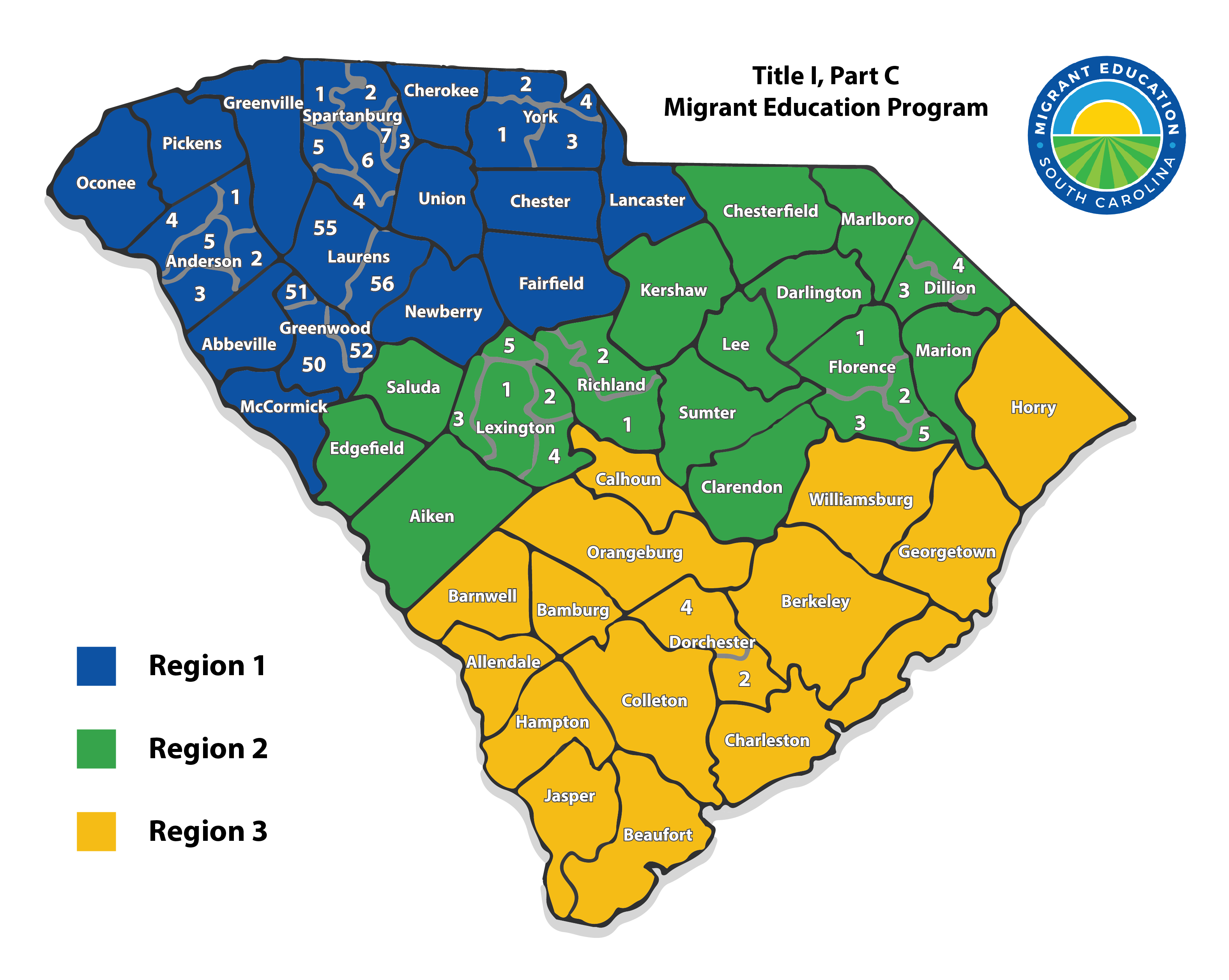
| Region 1 Contact |
Role |
Email |
Phone |
| Marcela Hernandez |
Family Liaison |
amhernandez@ed.sc.gov |
803-521-9562 |
| Emily Williams |
Part-time Recruiter |
ewilliams@ed.sc.gov |
803-542-0387 |
| Region 2 Contact |
Role |
Email |
Phone |
| Darren Truel |
Family Liaison |
dtruel@ed.sc.gov |
803-351-2099 |
| Victor Pacheco |
Part-time Recruiter |
vpacheco@ed.sc.gov |
803-394-8478 |
| Region 3 Contact |
Role |
Email |
Phone |
| Brenda Sierra |
Recruiter |
bsierra@ed.sc.gov |
803-509-3675 |
| Allison Singer |
Family Liaison |
asinger@ed.sc.gov |
803-391-9827 |
